

If you have a power recliner stuck in one direction—or frozen entirely—it rarely has a dead motor. The motor usually still works. However, something upstream has told the control box to stop sending current. Alternatively, something mechanical has bound the mechanism before the actuator can do its job. The following three-stage check moves from the cheapest and most reversible fixes toward the mechanical side. Stop at the stage that resolves the symptom. Do not skip ahead to motor replacement before you clear these three areas.
Stage 1: Hand Control Button & Thermal Reset for a Power Recliner Stuck
Before touching any tools, spend two minutes on the two variables that require no disassembly.
1. Check for a Stuck Button
If the recliner moves in one direction but not the other, the first suspect is the corresponding button on the hand control. The button may fail to spring back after you press it. A button that stays depressed keeps the control box in a continuous command state for that direction. As a result, the control box ignores or overrides the reverse command. Press each button several times and feel for a mushy, sticky, or non-returning action. If a button stays down, you need to replace the hand control itself—not the chair. You can view our replacement hand controls here
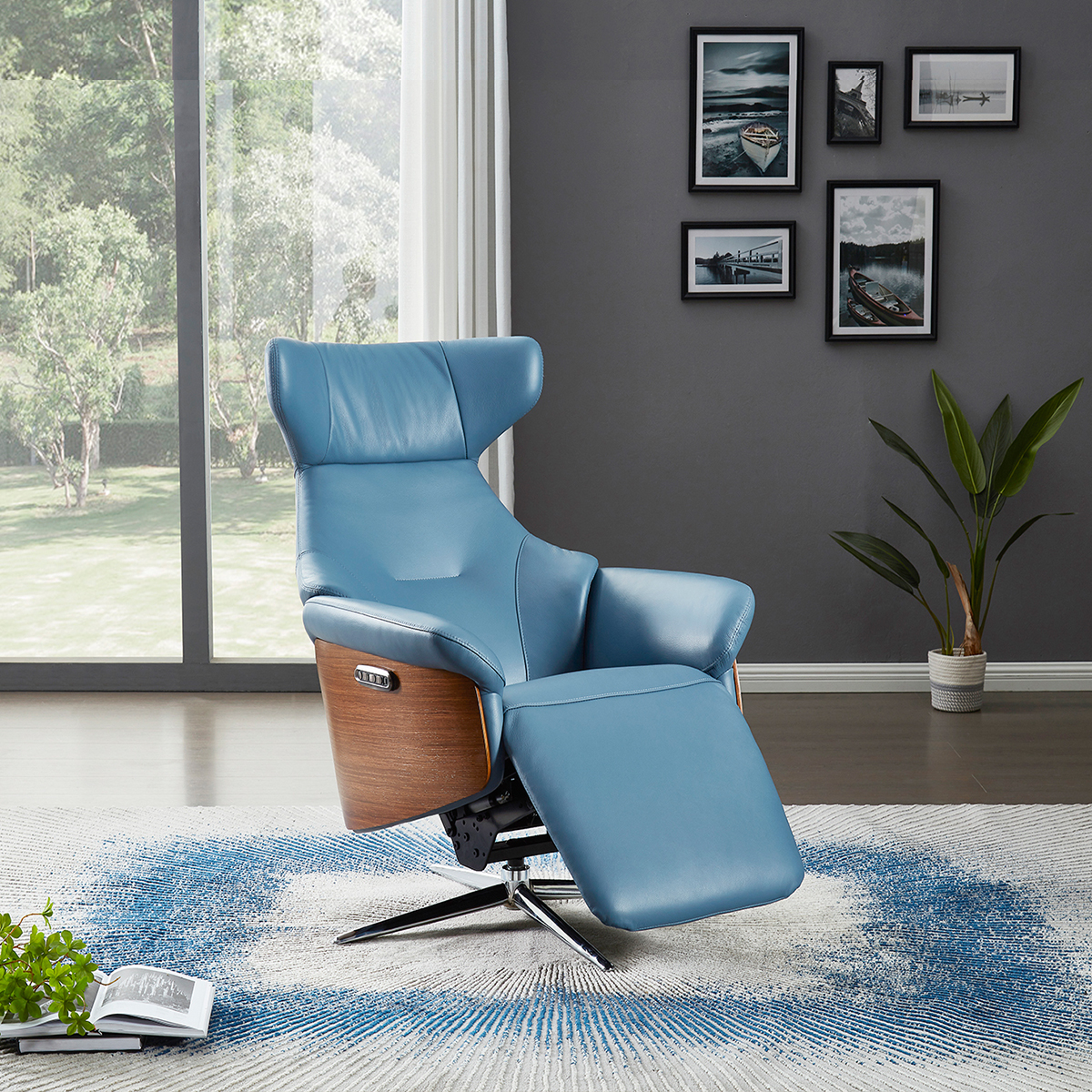
KM6003 Electric Recliner
Looking to upgrade? Discover our premium electric recliner with smooth power controls, ergonomic design, and a durable motor for long-lasting comfort.
View Product Details →2. Let the Thermal Cutoff Reset on a Power Recliner Stuck
If your power recliner is stuck, it may be due to an overheated motor. Many power recliner transformers and motor control boxes contain an internal thermal shutoff switch. If the motor runs repeatedly against a bind, it overheats. This switch then trips and cuts power to the motor to prevent damage. The reset is not instant. Allow the unit to remain stationary for 10 minutes (some manufacturers specify 10–15 minutes) before testing again. If the chair resumes normal operation after the cooldown, the root cause was overheating. However, if it trips repeatedly, a downstream load fault (bind or failing actuator) needs the mechanical checks below.
3. Quick Diagnostic: Listen to the Motor
Press a button and listen near the motor.
- Humming or clicking, but no movement → Power is reaching the actuator. Suspect an internal actuator gear failure or a mechanical bind. Proceed to Stages 2 and 3.
- Completely silent → The system stops the signal or power before it reaches the motor. Check the OKIN diagnostic lights below before assuming a mechanical problem.
OKIN Diagnostic Light Codes (If Equipped)
On OKIN wireless hand controls, both indicator lights flashing 3 times is a specific fault signal. Either the remote failed to pair with the control box, or the control commands cannot reach the control box. This points to a connection or pairing issue, not a limit switch or linkage bind. Re-pair the handset before pursuing mechanical causes.
Stage 2: Limit Switch Diagnostics When Your Power Recliner Is Stuck
Limit switches inside the actuator tell the control box when the travel endpoint has been reached. When a limit switch trips and fails to reset—or when its wiring is disturbed—the control box can lock out both directions even though the motor itself is intact. This is why a “completely dead” chair does not automatically mean a motor failure.
How to Tell a Limit Fault from an Actuator Fault
- The chair stops at a consistent position every time, and the reverse direction is completely unresponsive. A limit switch that is stuck open or mispositioned is a primary candidate.
- The chair moves freely in one direction but the other direction is either dead or produces a strained hum. This pattern—one-way operation—is more often caused by uneven internal wear in the actuator gears. The actuator’s internal components can wear unevenly. This allows movement in one direction while the opposite direction binds internally.
What to Check When a Power Recliner Is Stuck (Power Disconnected)
Inspect the low-voltage connector at the control box and at the actuator. A partially seated or loose connector can interrupt the limit-switch circuit while leaving the main power circuit intact. Reseat every low-voltage plug firmly. Also trace the cable for pinch points. A cable caught in the linkage or pulled tight against a wall can produce intermittent or directional-only failures.
[Insert Image: Low-voltage connector at the control box]
Do not adjust limit switch set screws as a first response. On many actuators, the factory calibrates the limit settings. Random adjustment can move the mechanical stop out of sync with the internal switch, creating a new failure mode. If you must replace the actuator, the limit calibration travels with the new unit.
Stage 3: Linkage Bind and Mechanical Fixes for a Power Recliner Stuck
When the motor hums but the chair does not move, the fault has moved from electrical to mechanical. Stop pressing buttons repeatedly. Sustained stall current is exactly what the thermal cutoff in Stage 1 is protecting against.Repeated resets without finding the bind can damage the actuator. Finding the physical bind is the key to fixing a power recliner stuck in its tracks.
Check Point 1: Linkage Fasteners and Pivot Points
The scissor-style linkage that raises and lowers the seat relies on bolts, pins, and pivot joints. Over time, vibration and the side loads from users pushing up on the armrests can back bolts out or shift a linkage arm out of alignment. A bent linkage arm, a missing pin, or a backed-out bolt will create a hard bind at a specific point in the travel. With the power disconnected, run a hand along each visible linkage segment and look for missing hardware or a rod sitting at an angle it should not be.
[Insert Image: Scissor-style recliner linkage mechanism]
Check Point 2: Foreign Object Intrusion
A coin, a pet toy, or a piece of clothing wedged between the linkage and the frame is a common cause of a sudden power recliner stuck condition. The chair worked yesterday and is dead today. Use a flashlight and inspect the full travel path before forcing anything.
Check Point 3: Lubrication State at the Pivot Joints
A dry pivot can seize enough to stall the actuator. Apply a silicone-based spray or dry lubricant to the exposed pivot points. Avoid heavy grease, as it will attract dust and hair into the joint.
The Manual-Override Boundary
Some power recliner mechanisms include a manual override or release feature. This design allows you to return the chair to an upright position without power. This feature is for emergency repositioning, not for diagnosis. If the linkage is visibly bent, a pin is missing, or a foreign object is wedged in the mechanism, do not force the chair through a manual override. Forcing it can convert a repairable bind into a bent or cracked structural component. Confirm that the mechanism is structurally intact before using any override function.
When to Stop and Call Service
Stop self-diagnosis and arrange professional service when any of the following are present:
- The transformer or control box emits a burning smell, visible scorching, or sparking.
- The actuator hums but does not move after the linkage has been confirmed clear. This indicates internal actuator failure and requires part replacement, not adjustment.
- The chair has failed after two thermal reset cycles with no obvious bind found.
- Linkage components show cracks or severe deformation.
- The recliner is still under warranty. Disassembling the actuator or control box may void coverage.
Bottom line
When you find your power recliner stuck, work from the hand control and thermal reset outward. A stuck button and a tripped thermal switch account for a meaningful share of “dead recliner” calls. A one-way-only pattern points toward the actuator’s internal wear. Meanwhile, a sudden freeze with a humming motor points toward linkage bind or a foreign object. You should suspect the motor last, not first.